

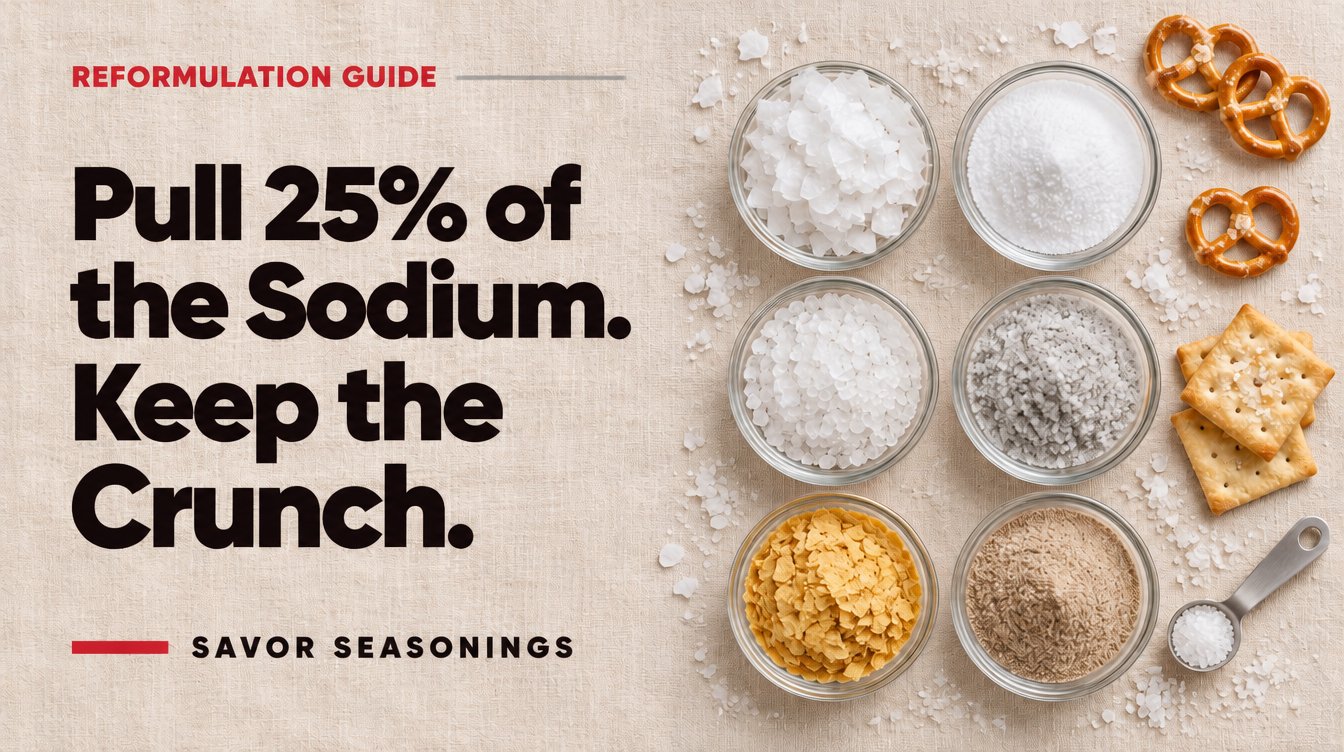
With the right sodium reduction approach, you can cut a meaningful share of sodium from a snack seasoning without your sensory panel catching it. The trick is to stop treating salt as one ingredient and start treating it as a delivery problem: where it sits, how fast it dissolves, and what else is carrying the flavor.
Here’s the uncomfortable part. A study out of Johns Hopkins this past summer looked at new packaged foods and found sodium levels had barely moved since 2021. Barely. Years of voluntary FDA targets, plenty of press releases, and the needle mostly sat still.
We don’t think that’s because nobody tried. We think most teams tried the obvious thing first: take salt out, swap in potassium chloride, run a panel, watch it fail. Then the project quietly dies on someone’s desk.
There’s a better order of operations.
Start with where the salt lives
Salt in the dough and salt on the surface do very different jobs. Topical salt hits the tongue first and fast. Salt baked into the base mostly just disappears.
So the first move is often not a substitute at all. It’s moving more of your sodium budget to the surface, where every milligram actually gets tasted. A lot of snacks are carrying salt in the base that’s doing very little work.
Then shrink the crystal
Finer salt dissolves faster. Faster means more of it registers as salty before you swallow. The same sodium in a smaller particle size can taste noticeably saltier, which means you can use less of it.
There’s a catch, and it’s the one from every adhesion conversation: go too fine and you’re making dust. Particle size has to be dialed in with the line, not just the bench.
Now bring in the helpers
This is where replacement and boosting tools come in. None of them is magic on its own. Stacked carefully, they get you real reductions.
| Tool | What it does | What to watch |
|---|---|---|
| Potassium chloride | Replaces some sodium directly | Bitter, metallic edge at higher levels |
| Yeast extracts | Adds savory depth that reads as “salty enough” | Label perception; can taste brothy |
| Mushroom and other umami sources | Fills the savory gap salt leaves | Flavor can drift earthy |
| Acids (citric, malic, vinegar powder) | Makes salt taste brighter and louder | Hygroscopic; watch caking |
| Aromatics (garlic, onion, cheese, herbs) | Gives the brain something else to taste | Has to fit the flavor profile |
Potassium chloride is usually the first thing people reach for and the first thing that breaks. Past a certain replacement level, the bitterness shows up, and no amount of wishful thinking hides it. Pairing it with umami and a little acid usually covers more ground than pushing KCl harder.
Don’t do it all in one jump
This is the big one. Trying to pull 25% in a single reformulation is how you end up with a product your loyal customers notice immediately.
Step it down instead:
- Pull 10% and run it in market.
- Let people get used to it.
- Pull the next chunk.
Palates adjust. They just don’t adjust overnight. A staged reduction over a few releases is a lot quieter than one big swing, and it gives you real consumer data at each step instead of one big bet.
Keep the flavor loud
A reduced sodium seasoning that tastes timid is a failed seasoning, even if it hits the number. When salt comes down, something else has to come up. Bolder spice, more acid, more toasted notes, a little more heat. The goal is a snack that tastes just as finished, not a snack that tastes like it’s apologizing.
We’ll admit it: our first reduced-sodium trials years ago were too polite. Lower salt, same everything else. They tasted flat. The good versions came when we stopped thinking “less salt” and started thinking “different balance.”
Why this is worth doing now
FDA’s sodium targets are still voluntary. That’s true today. But retailers, school and foodservice buyers, and a lot of health-minded shoppers aren’t waiting for a mandate. Having a reduced sodium version ready, or already in the line, is a much better spot than scrambling when a big customer asks for one.
It also pairs naturally with clean label work. If you’re already reworking a seasoning to drop artificial ingredients, that’s the moment to look at sodium too. Read our breakdown of what clean label actually means here.
How we help
Sodium reduction is a balancing act, and it’s very specific to your base, your flavor and your line. We build reduced sodium seasonings around how your product actually runs, then step the reduction down with you. Start a flavor project and tell us your current sodium number and where you want it to land.
We’ll tell you honestly how far we think you can get.
Frequently Asked Questions
How much sodium can you cut from a snack seasoning?
It depends on the base and flavor, but staged reductions of 10% at a time are common, and many products can go further over several releases without consumers noticing.
Why does potassium chloride taste bitter?
At higher replacement levels, potassium chloride brings a bitter, metallic note. Pairing it with umami, acids and aromatics helps cover it.
Does salt particle size affect saltiness?
Yes. Finer salt dissolves faster on the tongue, so it can taste saltier at the same sodium level.
Are FDA sodium targets mandatory?
No. FDA’s sodium reduction targets are voluntary as of now.


 Moocow Creative